Which Group Is at the Highest Risk of Vitamin B12 Deficiency
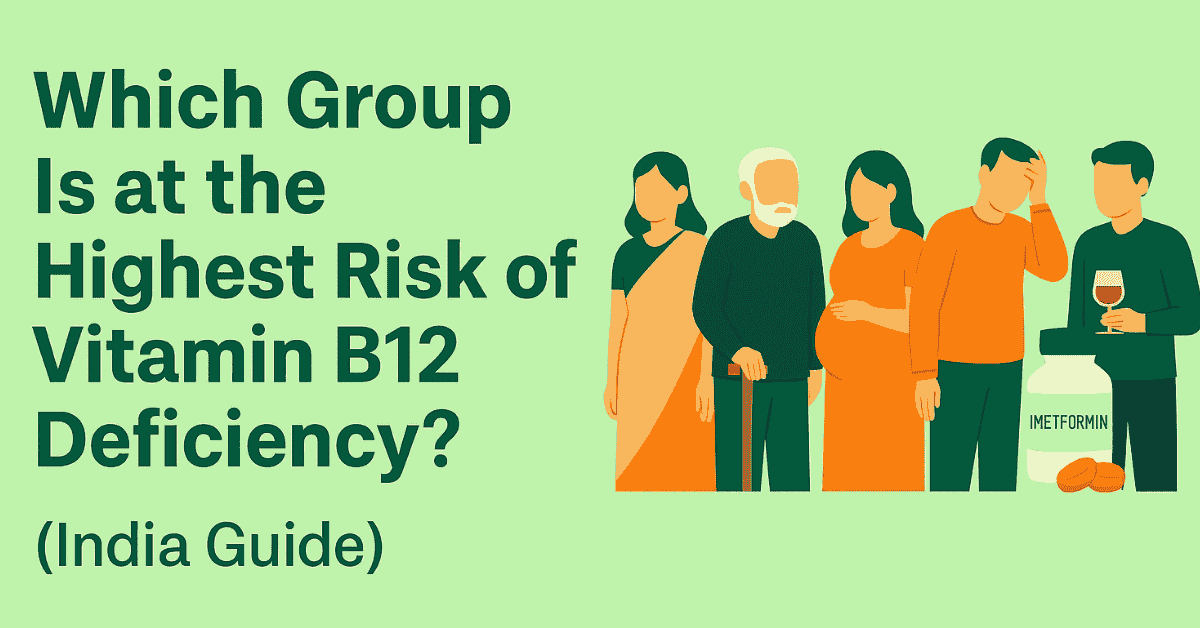
Which Group Is at the Highest Risk of Vitamin B12 Deficiency? (India Guide)
Vitamin B12 is essential for red blood cell production, nerve health, brain function, and energy.
Yet deficiency is surprisingly common in India. Some groups of people are much more likely to become B12 deficient because of their diet or health conditions.
Knowing if you belong to a high-risk group can help you prevent serious complications like anemia, nerve damage, and memory loss.
Why Vitamin B12 Matters
Your body needs vitamin B12 (cobalamin) to:
- Produce healthy red blood cells that carry oxygen.
- Protect and repair nerves via the myelin sheath.
- Support memory, focus, and mood.
- Convert food into energy.
- Make DNA and new cells.
Unlike some vitamins, B12 is found naturally only in animal-based foods — this is one big reason deficiency is common in India.
Recommended Daily Intake (RDA)
- Adults: 2.4 mcg/day
- Pregnant women: 2.6 mcg/day
- Breastfeeding women: 2.8 mcg/day
Even though this is a small amount, poor diet and absorption problems can make it hard to reach.
Groups at the Highest Risk of Vitamin B12 Deficiency
1. Vegetarians and Vegans
- Why: Natural B12 is found in meat, fish, eggs, and dairy. Plant foods don’t contain reliable B12.
- In India, a large population follows vegetarian diets, making deficiency very common.
- Vegans (who avoid dairy and eggs) are at the highest risk.
Tip: Vegetarians should include milk, curd, paneer, and fortified foods. Vegans almost always need supplements.
2. Elderly People (Above 60)
- Why: With age, the stomach makes less acid and intrinsic factor, needed to absorb B12.
- Many older adults also eat less or have poor appetite.
3. Pregnant and Breastfeeding Women
- Why: B12 needs increase during pregnancy and breastfeeding for the baby’s brain and nerve development.
- If a mother is vegetarian and low in B12, her baby may also become deficient.
4. People With Digestive Disorders
- Conditions like:
- Chronic gastritis
- Celiac disease
- Crohn’s disease
- Tropical sprue
- Ulcer surgery or weight-loss (bariatric) surgery
- Why: These reduce absorption in the stomach and small intestine.
5. People Taking Certain Medicines Long-Term
- Metformin (for diabetes): Can lower B12 absorption.
- Acid-reducing medicines (PPIs, H2 blockers): Reduce stomach acid needed to release B12.
- Some seizure medicines can also affect absorption.
6. Chronic Alcohol Drinkers
- Why: Alcohol damages stomach lining and liver, making B12 absorption poor.
- Heavy drinkers often have multiple nutritional deficiencies.
7. People With Pernicious Anemia
- An autoimmune condition where the body can’t make intrinsic factor, a protein required to absorb B12.
- Rare but causes severe, long-term deficiency.
8. Malnourished or Fad Diet Followers
- Crash diets, extreme calorie restriction, or poor meal diversity can lower B12 intake.
Signs You May Be Deficient
- Persistent fatigue and weakness
- Pale or yellowish skin
- Tingling or numbness in hands and feet
- Difficulty walking or poor balance
- Memory problems or brain fog
- Depression or mood changes
- Mouth ulcers and sore tongue
Important: Severe deficiency can cause permanent nerve damage if not treated early.
How to Prevent B12 Deficiency (If You’re High-Risk)
For Vegetarians & Vegans
- Daily dairy: Milk, curd, paneer, cheese.
- Fortified foods: Breakfast cereals, nutritional yeast, plant-based milks with added B12.
- Supplements: Consider 250–500 mcg daily or 2000 mcg weekly (safe and effective).
For Elderly Adults
- Get B12 levels checked annually.
- Consider B12 tablets or sublingual supplements (500 mcg) if levels drop.
For Pregnant & Breastfeeding Women
- Take prenatal vitamins with B12.
- Vegetarians may need additional supplements — ask your doctor.
For People With Stomach or Intestinal Problems
- Oral high-dose B12 or injections may be needed if absorption is poor.
For Medicine Users (Metformin, PPIs)
- Test serum B12 every 1–2 years and supplement if low.
B12 Supplement Safety
- B12 is water-soluble, so extra amounts are usually safe and excreted.
- No official upper limit exists because toxicity is rare.
- Even 1000–2000 mcg/day is safe if you’re deficient.
FAQs About B12 Deficiency Risk
1. Who is most likely to have vitamin B12 deficiency in India?
Vegetarians and vegans are at the highest risk, followed by the elderly and those with digestive disorders.
2. Why are vegetarians prone to B12 deficiency?
Because natural B12 comes mostly from meat, fish, eggs, and dairy. Plants don’t have enough.
3. Can pregnant women be deficient?
Yes, especially if vegetarian. Low B12 can affect the baby’s brain and nerves.
4. Do older adults need B12 supplements?
Often yes, because absorption declines with age.
5. Can medicines cause B12 deficiency?
Yes. Metformin and acid blockers (PPIs) can reduce B12 absorption.
6. How do I know if I need testing?
If you’re vegetarian, older, pregnant, on long-term metformin/acid blockers, or have nerve symptoms, ask for a serum B12 test.
7. Is B12 deficiency reversible?
Usually yes if treated early. Long-term nerve damage may be permanent.
8. Are fortified foods enough for vegans?
They help but usually supplements are still needed.
9. Can alcohol cause B12 deficiency?
Yes. Alcohol damages stomach lining and liver, making absorption poor.
10. How often should high-risk people test B12 levels?
Once every 1–2 years or if symptoms appear.
Final Takeaway
The highest risk groups for vitamin B12 deficiency are:
vegetarians and vegans, older adults, pregnant and breastfeeding women, people with stomach or intestinal problems, those taking metformin or acid blockers, and heavy alcohol users.
If you belong to any of these groups, get your B12 level checked, include B12-rich foods, and consider supplements if needed.
Early prevention can save you from serious problems like nerve damage, memory loss, and anemia.




Post Comment